
Researcher: Smriti Ranabhat
Editor: Nuva Rai
Risk of Data Privacy and Protection
Nepal is rapidly digitalizing its state infrastructure, yet it continues to treat da
ta protection as an afterthought. As similar to previous months, this month too, we observed reports of repeated data leak incidents. Recently, the University Grants Commission sensitive information of thousands of students and professors were leaked due to a cybersecurity flaw. Additionally, the Company Registrar’s Office introduced an AI-based call centre but concerns have grown about where data is stored and who has access to it. Experts worry that foreign technology providers may gain access to sensitive personal information without clear safeguards. For marginalized communities like queer individuals operating businesses under precarious legal conditions, the opaque handling of their corporate and personal da
ta exposes them to potential surveillance, state overreach, and community outing.
Furthermore, the government is planning to advance border security through facial recognition, drones, night-vision cameras, and integrated surveillance systems. These tools are justified as an effort to strengthen national security. However, this techno-solutionism completely ignores how surveillance technologies replicate systemic biases. Facial recognition algorithms are notoriously inaccurate when reading women, non-binary, and non-Western faces, increasing the risk of false positives and wrongful targeting.
On the bright side, the Supreme Court has made a historic decision on the protection of privacy. It ordered the Department of T
ransport Management from publishing citizenship numbers in driving licence results affirming privacy as a fundamental constitutional right. While this sets a critical precedent against the state’s habit of discarding privacy for administrative convenience, judicial remedies remain out of reach for the vast majority of Nepalis. Until Nepal implements an intersectional legal framework alongside independent regulatory oversight, data digitalization will remain a tool that concentrates state power while leaving marginalized communities structurally exposed.
How Nepal’s Legal Machinery Protects Elites and Silences Critical Expression
In Nepal’s current legal and policy landscape, this month we observed an increasingly restrictive environment in regards to freedom of expression; characterized by the systemic weaponization of state mechanisms and judicial overreach to shield political and corporate elites from accountability.
MP Jagdish Kharel filed a complaint against Rajdhani Daily over a news report about him. There seems to be a conflict between reputation protection and journalistic accountability. Public figures have the right to challenge inaccurate reporting, but using multiple state and quasi-state mechanisms, such as the Press Council and Cyber Bureau, raises concerns when such practices become inst
ruments of intimidation. Kharel’s public demand for an apology demonstrates how traditional norms of patriarchal honor are codependently enforced by state mechanisms. While the Cyber Bureau acts instantly to defend cis-male politicians, it has been observed to have failed to do so when women, queer folks, and marginalized activists seek protection from coordinated online gender-based violence (OGBV), doxxing, and death threats.
Similarly, the Kathmandu District Court made an interim order directing the removal of news articles from Bimapost. As an ex parte order, it weakens the principle of audi alteram partem (right to be heard) and affects investigative journalism, particularly in matters that affect the public interest, such as taxes and governance. This calls for judicial restraint, since prior restraint on publication directly undermines constitutional guarantees of press freedom and may lead to routine takedowns without competitive review.
Extractive Stroy-telling under the guise of Creative Freedom
For generations, Indigenous Badi com
munity has resisted caste, class, and gender-based marginalization. When their lived experiences and identities are flattened into cinematic tropes without their explicit consent, it constitutes a violation of Free, Prior, and Informed Consent (FPIC). Communities must have the right to self-determine how their histories and identities are digitized, packaged, and distributed.
When filmmakers bypass FPIC under the guise of “exploring sensitive social realities,” they engage in a form of storytelling that reinforces harmful, reductionist stereotypes. For a marginalized community, a reckless representation on screen is not just an aesthetic flaw; it acts as a direct catalyst for real-world social harm, systemic discrimination, and heightened vulnerability to harassment.
The Patan High Court had temporarily stopped the screening of the movie “Lalibazar” and the ban came with mixed reactio
ns. Many artists and filmmakers viewed the intervention as a form of censorship and a potential threat to creative freedom. They argued that cinema should have space to explore sensitive social realities without undue restriction. On the other hand, members of the Badi community and activists expressed concern that the film may reinforce harmful stereotypes and contribute to further social harm. This situation reflects a broader challenge in Nepali cinema, where social storytelling often intersects with questions of representation and cultural sensitivity.
Later, the Patan High Court refused to extend the interim order and allowed the screening of the film which highlights the limitations of relying purely on state or judicial mechanisms to mediate representation. To resp
ect the dignity of marginalized populations, the Nepali film industry must shift from a model of extractive representation to one of co-creation. This requires participation of community members directly into the creative process. Ensuring that marginalized voices hold decision-making power in how their stories are told guarantees that cinema acts as a tool for structural accountability and collective healing, rather than a vehicle for dominant-group voyeurism.
A Critical Read of Nepal’s FY 2083/84 Digital Budget
The government’s budget for Fiscal Year 2
083/84 positions technology, artificial intelligence, and massive digital infrastructure as the primary engines of economic growth. The government has allocated 5.93 billion under the heading of information and communication, while 4 billion under the heading of Science, Technology and Innovation.
It has forwarded Tax exemptions for IT service exports, startup incentives such as sweat equity relief, and plans for a Sovereign AI Compute Center aim to strengthen global competitiveness and move Nepal beyond traditional outsourcing services. The budget further prioritises digital governance through initiatives such as e-courts, paperless taxation, integrated land systems, and expanded e-payment infrastructure. These measures seek to improve effici
ency, transparency, and service delivery while promoting data-driven governance.
However, the budget focuses heavily on large-scale infrastructure while providing limited support for small and medium IT enterprises. Which could lead to concentration of wealth within a few dominant, elite-owned tech professionals. As AI systems expand into public services, the budget leaves a vacuum regarding data privacy and systemic bias as the budget does not clearly outline safeguards to address these risks as digital systems expand.
Ultimately, the FY 2083/84 budget prioritizes global market competitiveness over domestic social justice. Nepal’s past experiences have shown ambitious digital reforms will fail and cause active harm if they continue to treat tech infrastructure as separate from human rights. Digital advancement requires shifting away from extractive tech-imposition toward a framework where digital infrastructure is built only with community consent, clear environmental safeguards, a
nd data protection that centers the safety of marginalized people.
Technocracy, Digital Divide and Marginalized Leaders
The growth of digital public services, including the Nepal Police mobile app, shows progress toward more accessible and responsive governance. These platforms can enhance transparency and citizen engagement by enabling people to access services remotely. However, this narrative assumes a co
mpletely neutral user. In reality, access to devices and data within Nepali households is deeply patriarchal. Women, Person with Disability and queer youth often do not have autonomous smartphone access, as their internet usage is heavily surveilled, restricted, or controlled by male family members. For a survivor of domestic or gender-based violence, an app-based reporting system is useless if she cannot safely access a device. Furthermore, expanding digital policing without addressing the institutional biases within law enforcement simply digitizes existing state surveillance, making these tools a source of threat rather than safety for marginalized and criminalized bodies.
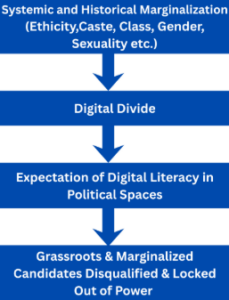
Digital divide, often treated as an infrastructural problem, is also a result of a system of gendered, caste-based, and class-based exclusion. This exclusion is now being formalized within the political sphere. The Rastriya Swatantra Party has added its requirement that election candidates should possess basic digital literacy, knowledge of e-governance systems and awareness of cyber ethics. This reflects expectations for public leadership with digital skills viewed as essential for effective participation in governance and politics. This could risk a shift toward technocratic gatekeeping of political spaces. As, to expect digital competence from candidates without addressing patriarchal and economic barriers that prevent them from acquiring those skills is to actively gatekeep the mainstream political sphere. By equating digital fluency with leadership capability, this policy ignores the realities of Nepal’s uneven educational and technological landscape. Generations of structural discrimination mean that Dalit, Indigenous, Madhesi, queer, people with disabilities and rural women have been systematically denied access to digital resources. This dynamic makes the political sphere inaccessible to grassroots leaders who possess experience in community organizing, replacing them with a compliance driven elite who look progressive on a screen but remain detached from the lived struggles on the ground.
Evolving Landscape of Digital Harm in Nepal
The digital ecosystem in Nepal reflects the societal patriarchy where technology-facilitated gender-based violence (TFGBV), systemic misogyny, and predatory financial scams operate side by side. The incidents observed this month show that digital harm is a structural crisis and not a technical anomaly. Public platforms and private digital spaces are increasingly weaponized to police, exploit, and terrorize women, queer individuals, and marginalized communities.
The experiences shared by actress and political leader, Nisha Adhikari have shown that trolling and online harassment can rapidly shape public perception, damage reputations, and amplify unverified narratives. Digital spaces are mobilized to destroy the agency of women in public and political spheres. This is bigger than reputational damage as digital misogyny is designed to silence women who occupy positions of visibility. Big Tech platforms are complicit in this violence as their algorithms are engineered to optimize engagement by amplifying outrage, sensationalism, and hyper-sexualized narratives.
Digital harms are also being translated to financial risks with the rise of online scams. Scammers exploit human trust and vulnerability through digital platforms through fraudulent links and/or an alert message. This month, we also observed a case of online money extortion where the perpetrator weaponizes non-consensual intimate images and videos to threaten women. Labeling this as blackmail sanitizes image-based sexual abuse a violation of bodily autonomy and digital privacy.
These developments indicate that digital harm in Nepal now exists on a broader spectrum that includes reputational damage, financial exploitation, privacy violations, and gender-based violence. However, the law repeatedly fails to protect marginalized people because it views TFGBV through a lens of moral policing rather than digital rights. To create a safer, more trustworthy online environment, we need critical digital literacy, more responsive law enforcement, effective survivor-centered support mechanisms, and greater accountability from digital platforms.
References:
-
- https://techpana.com/2026/156494/ugc-data-breach-130k-students-3k-faculty-exposed-due-to-developer-error
- https://nepalpress.com/2026/05/13/723863/companies-registrars-ai-call-center-risks-to-business-firms-from-information-leaks-to-national-security/
- https://techpana.com/2026/156612/government-to-use-facial-recognition-system-at-border-areas
- https://www.setopati.com/social/388304https://www.reportersnepal.com/2026/05/1204482/
- https://english.khabarhub.com/2026/11/548281/
- https://nepalconnect.world/caste-culture-and-survival-story-of-the-badi-community/
- https://himalpress.com/2026/04/lalibazar-film-court-censors-after-censor-boards-approval/
- https://www.ratopati.com/story/561412/the-road-to-screening-of-the-film-lalibazar-is-open
- https://techsansar.com/computing/nepal-budget-2083-84-tech-it-innovation-reference/
- https://www.technologykhabar.com/2026/05/29/241992/https://techpana.com/2026/156972/nepal-budget-2083-84-it-and-ai-ambitious-vision
- https://nagariknews.nagariknetwork.com/social-affairs/now-you-can-file-a-police-complaint-from-home-using-a-mobile-app-86-76.html
- https://techpana.com/2026/156498/rsp-candidates-must-have-digital-skills-no-cyber-abuse-or-fraud-history
- https://techpana.com/2026/156483/from-street-harassment-to-online-trolling-nisha-adhikari
- https://techpana.com/2026/156900/mobile-sms-alert-bank-account-drained-13-member-cyber-gang-case
- https://www.nepalpolice.gov.np/news/9516/