-Birat Bijay Ojha
Once, my bullies who went to the same school as me sat with me, and I knew the government names of their three generations. Fast forward to now, with the advancement of the internet, the bullies have entered the chat — oftentimes, faceless, nameless, and usually more hateful.
I have had my fair share of encounters with these online bullies, from Instagram and X to Grindr, you name it. The most recent encounter began when I dared to question the legacy of a celebrity after his passing.
After the passing of Nirmal Purja, tributes poured in from across the world, filled with a lot of grief, admiration, and glorification of his achievements. What was missing from that morning, or barely seen, was solidarity with survivors of his sexual assaults.
Seeing the overwhelming love and support for him, I felt the allegations against him should be his legacy, too. So I went online and posted stories highlighting that and later turned them into a carousel post.
While I expected some forms of engagement on the post, the way it blew up was not something I had anticipated. As with any viral post on the internet, mine also got a lot of comments; several of which were unkind and hurtful.
The comments weren’t simply disagreements. They were direct attacks on my queerness. The conversation shifted from the allegations to protecting the image of a public figure, and it became clear that marginalized voices are often met with policing and backlash when they raise questions of accountability about someone the masses celebrate.
My identity was targeted simply because I chose to highlight the accusations against their hero instead of celebrating him alongside them. Rather than address the issue at hand, people questioned, criticized, and discredited me because of who I am. The backlash only reinforced something I have always challenged: the silencing of queer dissent.
Unfortunately, it was not my first rodeo with having queerphobic comments hurled at me for putting out something online that pisses people off. In November last year, while the interim government led by Prime Minister Sushila Karki was promoting the upcoming elections, one of its campaign flyers featured an illustrated person with a Pride badge pinned to their shirt pocket.
Unsurprisingly, it got on the nerves of a lot of Nepali conservatives. While scrolling through X, formerly Twitter, I saw one post a person made calling it subconscious-level programming as if queer people were some virus. As I usually do, I quoted the post calling it out. These were my exact words.
“Queer people have existed long before you came and will continue existing long after you’re gone. We are not some propaganda or agenda you think you can discard. We are living, breathing human beings. We are here, and we are queer. Keep crying about it.”
And that was enough for the queerphobes to rally in the quotes and comments, attempting to tear me to shreds with every ounce of hatred. From being called woke nonsense, filthy ideology, mental disorder, and degenerate and obviously some harsh derogatory words, the hate comments came in numbers that outweighed words of understanding or support.
These are just two instances I have endured while navigating digital spaces as an openly queer person. I have numerous similar accounts of being at the receiving end of hatred online when raising my voice on queer issues or simply expressing my thoughts and opinions on issues that are not necessarily queer.
Online hate does not get to you until it does. I used to think I had experienced worse in real life; I cannot let these faceless profiles (mostly) get to me. But when it happens more than once, you start questioning whether it is worth the time and energy to be brave and unapologetic. I do not think I am necessarily brave or unapologetic, but I can feel that I am expected to be, to live up to it. I’m simply trying to live my truth.
I’m adamant about exercising my freedom of expression without intending harm to others. But shouldn’t I have the option to not be brave in the first place?
I worry that labelling us as resilient and courageous when we deal with hate online normalizes the abuse we face, and strays us farther from actually addressing the core issue at hand — the lack of safe digital spaces for queer folks to be ourselves.
We are bullied into being resilient because we do not have other options other than being brave. And when this expectation of resilience and courage persists, it establishes that marginalized folks must endure violence: Our voice must have some pain infused in its weight: We must suffer cruelty first; only then is our suffering legitimate. But that credibility often comes with condescension, too.
But I do not want to be brave in the first place when voicing out my thoughts on human rights. Nor should I be subjected to uncalled-for nasty comments when I’m “brave” to be myself.
Considering the prominence of queerphobia in these spaces, it feels contradictory when I reflect on my journey. The internet was a large part of how I became unapologetically queer in the first place. I found people like me online, shared my poems and creative pursuits online and found support and solidarity. I made friends who have had similar experiences, and eventually became a part of a community that understands and supports me for who I am. This is the case for a lot of queer people. We get to find people like us in the virtual world, and it has given us hope and assurance that we are not alone in this.
My coming out to my father two years ago was also prompted by something I had shared online. Years ago, I also made a conscious decision to share those works online to find my people and also to let friends, family, and relatives connected via social media know about my work and what matters to me. Personally and professionally, my work oftentimes is extensively queer — I work in a queer organization, I write about queer issues, I create and hold space for queer arts — which is why I’m usually quite busy during Pride Month.
This way, I thought I could come out to them without having to say it out loud because I don’t think I owe going through that ordeal of coming out to everyone in person. I may not owe anyone coming out, but I can do enough to show online what I care about and who I am.
However, I did not get there overnight. It was a slow and steady pursuit that took years. Having that space to be myself online was, in a way, a stepping stone for me to fully embrace myself and let people around me know my truth.
The internet has been a solace for the most part. Other times, it has been a nightmare. When we are targeted for our identity simply for expressing our views, it pressures us to consider shrinking ourselves. And then we weigh our options to censor ourselves when, ironically, the internet was possibly the first place where we could actually be ourselves.
I may not be censoring myself fully just yet, but the fact that the thought has crossed my mind means that I’m going to be deliberate about how I express my queerness online or even voice opinions that are not queer-centric at all. That could mean being less vocal, making my accounts private, or choosing anonymity entirely for the sake of my mental health, as many queer folks in digital spaces already do.
The very space that once laid the foundation for me to find my voice is where now I’m struggling to fight silencing. This is the duality of navigating digital spaces as an openly queer person.
About Author
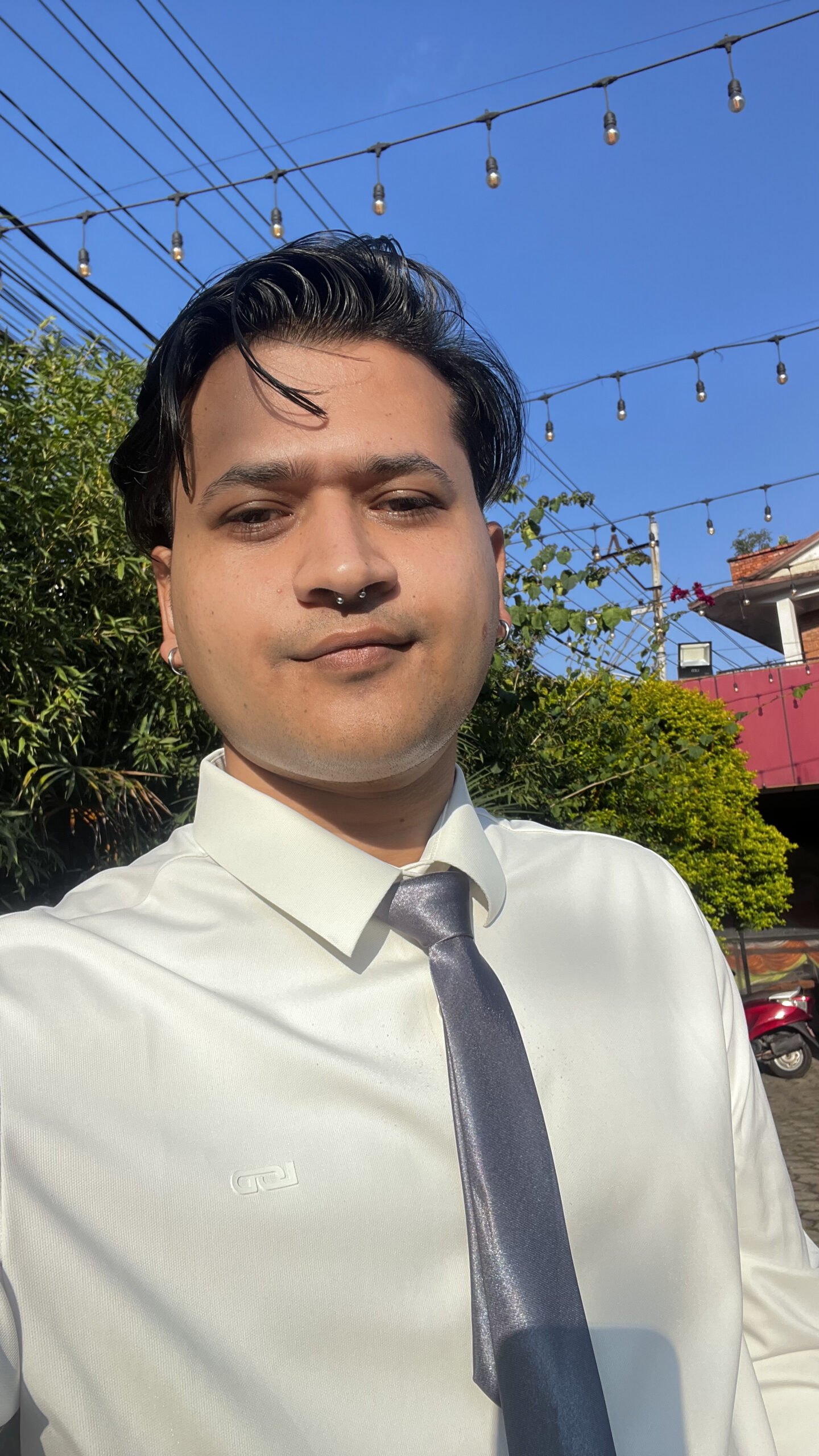
Birat Bijay Ojha (he/they) is a writer from Itahari working at the intersection of arts, media, culture, and communications. Their writing spans poetry, journalism, essays, fiction, creative nonfiction, and comics, exploring social, cultural, and political themes.
Their work has appeared in On the Brink of Belief (Penguin Random House, 2025) and Songs of Revolution (2022), the first anthology of Nepali queer poetry. They received third place in the 2023 UNESCO Nepal Poetry Competition. Their bylines have appeared in The Kathmandu Post, Onlinekhabar, Feminism in India, Gaysi Family, Astray Project, and Aawaaj News and Research.
Founder of Unicorn Chautari, a queer arts initiative, Birat currently serves on the board of Queer Youth Group.